
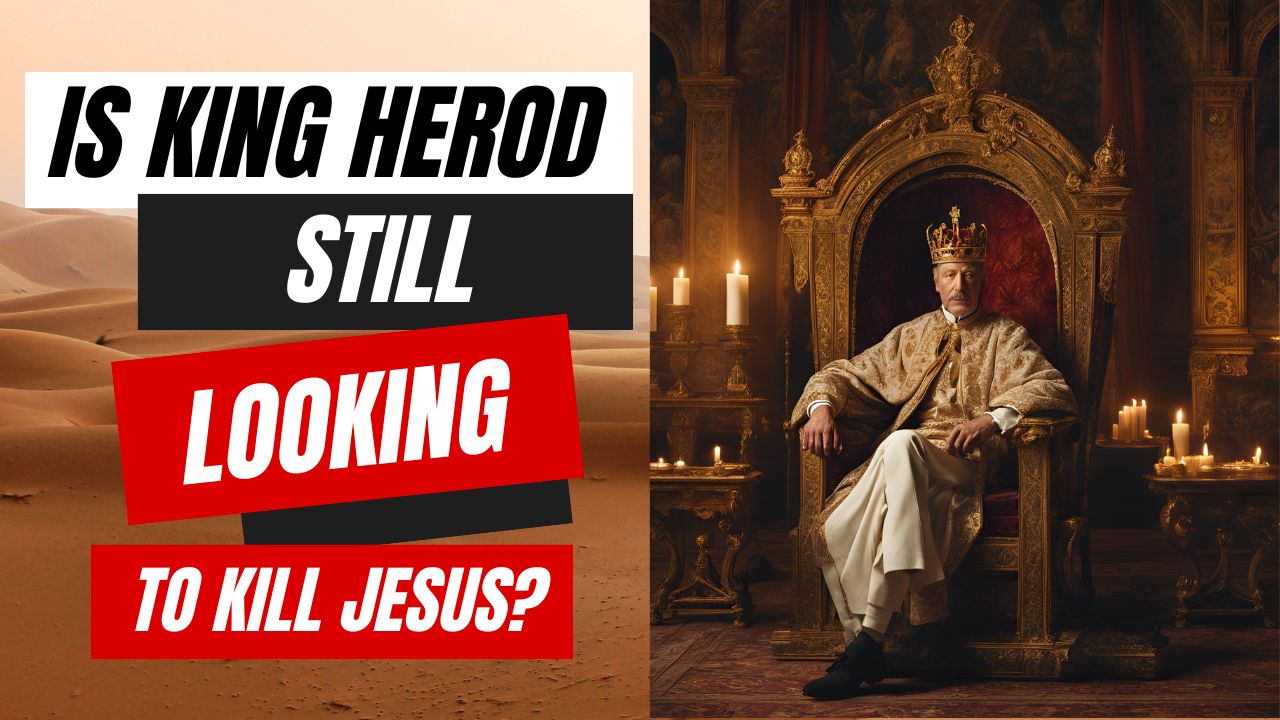
According to the Bible, King Herod, a Roman Jewish client king of the Herodian kingdom of Judea, was troubled and alarmed by the birth of Jesus:
“When Jesus was born in Bethlehem of Judea, in the days of King Herod,* behold, magi from the east arrived in Jerusalem, saying, “Where is the newborn king of the Jews? We saw his star* at its rising and have come to do him homage. When King Herod heard this, he was greatly troubled, and all Jerusalem with him. Assembling all the chief priests and the scribes of the people, he inquired of them where the Messiah was to be born. They said to him, “In Bethlehem of Judea, for thus it has been written through the prophet Mt 2:1-5
And you, Bethlehem, land of Judah, are by no means least among the rulers of Judah; since from you shall come a ruler, who is to shepherd my people Israel.’” Mt 2:6
Then Herod called the magi secretly and ascertained from them the time of the star’s appearance. He sent them to Bethlehem and said, “Go and search diligently for the child. When you have found him, bring me word, that I too may go and do him homage.” Mt 2:7-8
“When Herod realized that he had been deceived by the magi, he became furious. He ordered the massacre of all the boys in Bethlehem and its vicinity two years old and under, in accordance with the time he had ascertained from the magi.” Mt 2:16
People in power, like autocrats and royalty are usually threatened by anyone they suspect who is popular and a possible rival. Most people today could readily list some of the world’s most infamous dictators, particularly those of the twentieth century: Adolf Hitler, Benito Mussolini, Joseph Stalin, and Pol Pot.
Julius Caesar was assassinated by a group of senators who at the Curia of Pompey of the Theatre of Pompey in Rome where the senators stabbed Caesar 23 times. They claimed to be acting over fears that Caesar’s unprecedented concentration of power during his dictatorship was undermining the Roman Republic.
“Herod the tetrarch heard about all that was happening, and he was greatly perplexed because some were saying, “John has been raised from the dead”; others were saying, “Elijah has appeared”; still others, “One of the ancient prophets has arisen.”
But Herod said, “John I beheaded. Who then is this about whom I hear such things?” And he kept trying to see him.” Luke 9:7-9
Autocratic leaders frequently use religion as a mechanism to shape public behavior, secure legitimacy, and manage political opposition. Dictators often use financial patronage, special privileges, and state subsidies to bring religious institutions and leaders under government influence.
Autocrats adapt sacred language, imagery, and traditions to portray themselves as protectors of traditional values or instruments of divine will.
In various regimes, such as in contemporary Russia where the Russian Orthodox Church receives state backing, close alignment between political authority and religious leadership helps marginalize criticism
Constantine was the first emperor to legalize Christianity and allow complete religious freedom for Jews, Christians and pagans alike. Nonetheless, Constantine did not alter the empire’s state religion and the status of paganism as the state religion.
Throughout history, the Catholic and Orthodox Church sided with authoritarian kings, governments, monarchs, dictatorships and other unrestrained rulers.
Consider how the Catholic Church’s ProLife movement used Trump to appoint SCOTUS justices and try to contain LGBTQ persons from sports and the military.
American Catholic bishops remain a bit contained about protesting the Republican attempts to control the upcoming election while women religious groups, like The Leadership Conference of Women Religious, and The Black Sisters’ Conference are outspoken and are actively engaged in protecting voting rights.
King Herod is alive as well today. Beware!


